
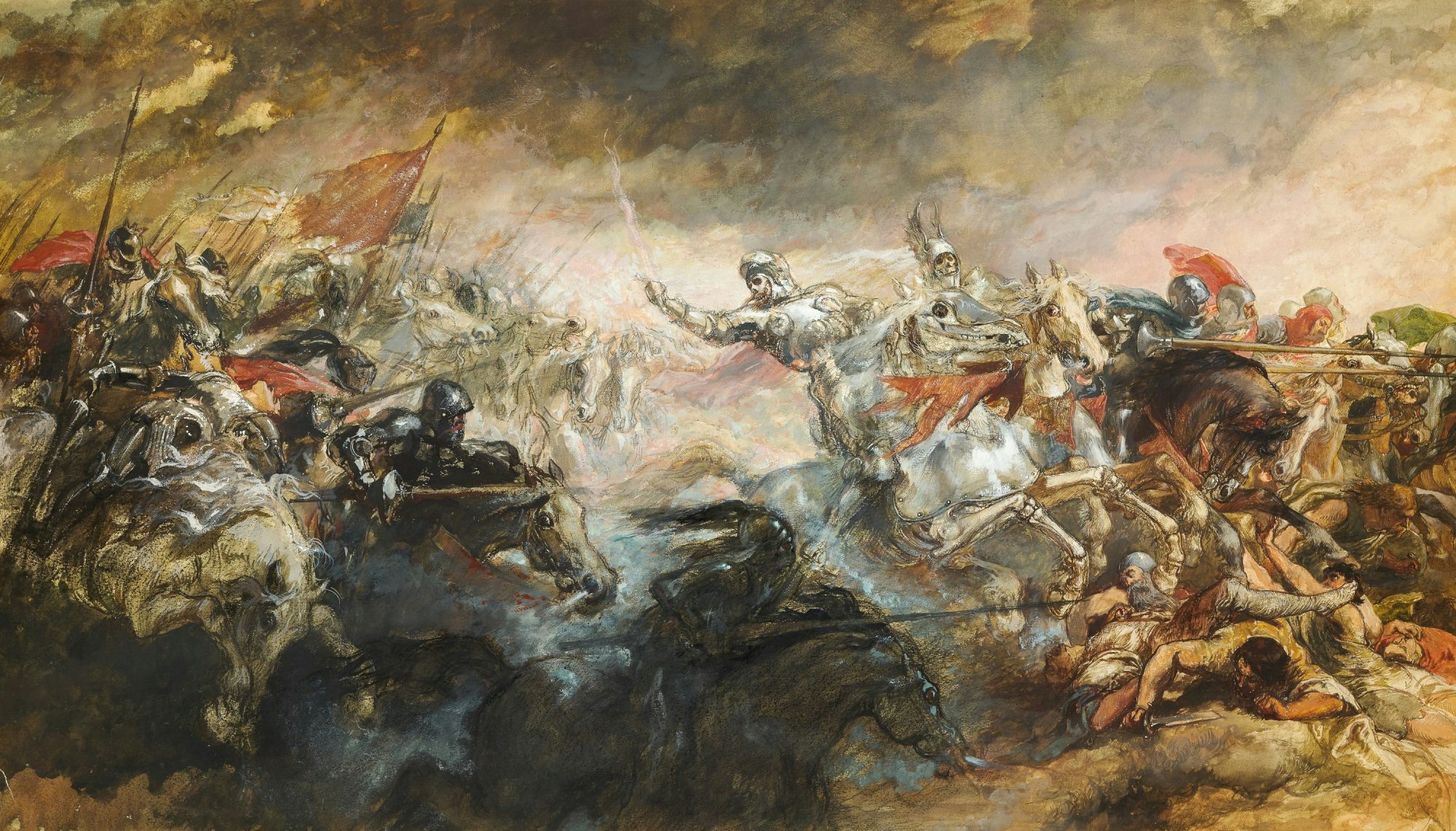
America and Israel’s war with Iran has caused excitement among some evangelical Christians for all the wrong reasons. The conflict has led them to believe that biblical end-time prophecies are being fulfilled right before their eyes.
John Hagee, founder of Christians United for Israel, described the war as part of God’s plan in a sermon on 1 March 2026, asserting that, “Prophetically, we’re right on cue.” Hagee ended his sermon with a prayer stating that, “God Almighty is brought into the battlefield and the enemies of Zion and the enemies of the United States can be destroyed before our eyes. Let God arise and let his enemies be scattered.”
Echoing this sentiment at a briefing, an American combat unit commander reportedly added that President Donald Trump has been “anointed by Jesus to light the signal fire in Iran to cause Armageddon and mark his return to Earth.”
The idea that this is not just another war, but the very fulfilment of Scripture, has captured the imagination of many evangelical Christians in America—not least those directly involved in the war. Ryan Zickgraf, a writer based in Pennsylvania, reports:
Since the launch of Operation Epic Fury, the Military Religious Freedom Foundation (MRFF) has been inundated with dozens of similar complaints from service members across every branch of military. The reports describe ‘unrestricted euphoria’ among commanders who believe they are not just fighting a war, but fulfilling the Book of Revelation itself.
The theology undergirding this view of the war in Iran and the Christian Zionism that accompanies it are shaped by a relatively new and novel approach to reading the Bible called Dispensationalism. This movement, with its distinctive interpretative framework, originated in England in the 19th century and very quickly spread to America and Canada.
While Dispensationalism has diversified over time, with revised and progressive forms modifying some of its sharper doctrines, this article focuses on classical and popular versions, which have most visibly influenced Christian Zionism and apocalyptic speculations.
It argues that classical and popular Dispensationalism is a doctrinal system that is constructed on an erroneous reading of the Bible and whose theological conclusions are inimical to those of orthodox Christianity.
What is Dispensationalism?
In 1827, John Nelson Darby (1800-1882), an Anglican priest who later joined the Plymouth Brethren, developed the view that God had two different purposes for his people.
There is, on the one hand, the earthly purpose for Israel and, on the other, the heavenly purpose for the Church. Darby taught that Scripture presents different “administrations” or “dispensations”, during which God dealt with humanity in distinct ways with different modes of divine governance.
In 1909, Cyrus Ingerson Scoffeld, a war veteran and pastor, published a study Bible —Scofield Reference Bible—whose interpretative matrix took fundamentalism by storm and became one of the bestselling Bibles in history. Drawing from Darby’s insights, Scofield developed the doctrine which states that there are seven recognisable dispensations, namely,
- Innocence – Adam
- Conscience – after the Fall
- Government – after the flood, human beings are allowed to eat meat, and the death penalty was instituted
- Promise – Abraham up to Moses, and the giving of the law
- Law – Moses to the cross
- Grace – the cross to the Millennial Kingdom
- Millennial Kingdom – a 1,000-year reign of Christ on earth centred in Jerusalem
Charles C. Ryrie, arguably one of the most influential voices in 20th century American Dispensationalism, summarises this new theology thus:
Dispensationalism views the world as a household run by God. In his household-world God is dispensing or administering its affairs according to his own will and in various stages of revelation in the passage of time. These various stages mark off his total purpose, and these different economies constitute the dispensations. The understanding of God’s differing economies is essential to a proper interpretation of his revelation within those various economies.
Dispensationalists adopt a literalistic hermeneutic belief that the Bible must be taken at face value. In their view, this is especially crucial for understanding biblical prophecies concerning Israel and the end times.
Dispensationalism also teaches that Christ will return and establish his reign on earth for a thousand years (premillennialism) during which God’s promises to Israel will be fulfilled. The Church will be raptured before Christ’s return and before the period of tribulation (lasting seven years), during which Israel will face trials and persecution.
Theologians Stanley Grenz, David Guretzki and Cherith Fee Nordling have summarised the main teachings of Dispensationalism thus:
God works within humans in distinct ways (dispensations) through history; that God has a distinct plan for Israel over against the church; that the Bible, especially predictive prophecy, needs to be interpreted literally; that the church will be secretly raptured from earth seven years prior to Christ’s second coming; that Christ will rule with Israel during a literal thousand-year earthly reign.
Many of the doctrines of classical and popular Dispensationalism are a radical departure from orthodox or historic Christian teaching. For example, the sevenfold scheme presented by Dispensationalism is not the way in which the Church has understood the biblical narrative or salvation history.
From the Church Fathers to the medieval theologians and Reformers, orthodox Christian theology has interpreted the Scripture narrative in broad categories such as Creation, Fall, Promise, Fulfilment and Consummation.
Similarly, historic Christianity does not teach that Christ will come secretly for the Church. Neither does it present the peculiar idea that Christ will reign with Israel during the millennium in the absence of the Church. The Dispensationalist eschatology is thus a novel, idiosyncratic and distorting reading of the Bible.
The Dispensationalist eschatology is thus a novel, idiosyncratic and distorting reading of the Bible.
Israel and the Church
Classical and popular Dispensationalists maintain a sharp distinction between the significance and destinies of Israel and the Church, which some writers have described as the two-fold theory of dispensationalism.
This theory is based on the “consistently literal principles of interpretation” employed by Dispensationalists as they read the Scriptures, especially the prophecies concerning Israel. They argue that just as the prophecies about Christ’s birth, death and resurrection were literally fulfilled, so also must prophecies about Israel be literally fulfilled.
Dispensationalists often criticise Reformed theology’s interpretation of the Old Testament (OT) prophecies because of its tendency to apply them to the New Testament Church instead of Israel. They reject what they regard as the “spiritualising” and therefore misapplication of ancient prophecies by Reformed theologians, even arguing that this is a slippery slope that may lead to liberalism.
Dispensationalists assert that the promises made to Israel in the OT apply to Israel only, unless God himself said otherwise. As Ryrie puts it clearly, “… the church did not begin in the OT but on the day of Pentecost, and the church is not presently fulfilling promises made to Israel in the OT that have not yet been fulfilled.”
Classical and popular Dispensationalists therefore teach that Israel and the Church are not the same entity. The former comprises the ethnic or national descendants of Abraham, Isaac and Jacob. The latter is the body of Christ formed at Pentecost and made up of Jews and Gentiles who have put their faith in Christ.
Dispensationalists therefore differ sharply from orthodox theology—represented by the Church Fathers, medieval schoolmen and Reformers—which teaches that the Church is the “new Israel” or the “spiritual Israel”.
Furthermore, classical and popular Dispensationalists also teach that because Israel and the Church are distinct entities, God has different plans for them.
For Israel, God has set up an “earthly programme” which includes the fulfilment of land promises, national restoration, and a future earthly reign of the Messiah. For the Church, God has put in place a heavenly programme that has to do with union with Christ, a heavenly identity and its status as the Bride and Body of Christ.
Dispensationalists also introduced the idea of the “Church Age” as the parenthetical phase in salvation history, a concept that has no precedence in orthodox theology. The Seventh-Day Adventist scholar Roy E. Gane explains the Dispensationalist’s concept of parenthesis as follows:
“… when Jesus was on earth he offered the earthly kingdom to the Jews. Because they rejected it, fulfilment of the Old Testament prophecies in regard to their rulership of Palestine and predominance over the nations could not be immediately put into effect. Of necessity there came a gap of centuries during which the Christian Church has played a separate and distinctive role designed by God. But this role is not a spiritual fulfilment of the Old Testament prophecies regarding Israel. The period of Christian Church history is a parenthesis, not foreseen by the Old Testament prophets and not designed to fulfil their forecasts. This period of the Church will come to an end when the Christian saints are secretly raptured seven years before the glorious appearing of Christ in the clouds of heaven.”
The parenthesis theory of Dispensationalism is deeply problematic from the standpoint of orthodoxy.
The Church is not an interruption of God’s plan or a contingency strategy but the Christological fulfilment of the divine plan. The Church is the Body of Christ (Ephesians 1:22-23), the Bride for whom Christ gave his life (Ephesians 3:10-11), and the eschatological gathering of God’s people in Christ.
The parenthesis theory weakens the unity of the people of God in Jesus Christ. Orthodox Christianity teaches that there is one people of God (Ephesians 2:11-22) and saw the Church as the fulfilment of Israel and the gathering of Jews and Gentiles into a new humanity.
Be that as it may, some Dispensationalists cast Iran, which is sometimes identified as “Persia”, in a symbolic role. Interpreting passages such as Ezekiel 38-39 within the hermeneutical framework described above, Iran is seen as part of the coalition of nations hostile to Israel.
Christian Zionism
This brings us to the connection between classical and popular Dispensationalism and Christian Zionism.
Dispensationalist theology is often regarded as providing both the inspiration and framework for Christian Zionism. However, it must be immediately emphasised that the two phenomena are somewhat distinct, and their relationship is extremely complex.
Before we examine their relationship, we must clarify what we mean by Christian Zionism. The best definition of Christian Zionism is provided by Stephen Sizer, the eminent scholar of this movement:
“At its simplest, Christian Zionism is Christian support for Zionism. The driving principle of Christian Zionism is the belief in the abiding relevance of the promise God made to Abraham in Genesis 12:3, ‘I will bless those who bless you and whoever curses you I will curse and all the peoples of the earth will be blessed through you.’”
Christian Zionists support the secular ideology of Zionism that is a national movement for the return of the Jewish people to Palestine and the sovereignty of the Jews over the whole land. They see themselves as defenders of, and apologists for, the Jewish people and in particular, the State of Israel.
Historically, Christian Zionism, whose early roots can be traced to the 16th century, predates Dispensationalism which, as we have seen, came into being only in the late 19th century. However, it can be argued that Dispensationalism has provided modern Christian Zionism its most influential and articulate theological form.
Not all Dispensationalists are Zionists. But it is not difficult to see how Dispensationalism often leads to and supports Christian Zionism: if God’s covenantal purpose for Israel has not changed, and if biblical prophecy points to Israel’s restoration, then it is obvious that Christians should bless, defend and support Israel.
Conclusion
When Dispensationalist Zionism is used as a lens through which to interpret the war on Iran which was begun by the United States and Israel, a real danger emerges. This is the danger of profound theological distortion: Christians may see the war not as a human tragedy to mourn, but as a prophetic event to welcome.
When Dispensationalist Zionism is used as a lens through which to interpret the war on Iran which was begun by the United States and Israel, a real danger emerges. This is the danger of profound theological distortion: Christians may see the war not as a human tragedy to mourn, but as a prophetic event to welcome.
This article was first published on 13 April 2026 by Ethos Institute.
You may wish to read this together with “Are we living in the end times? On reading eschatological signs”
Dr Roland Chia is Chew Hock Hin Professor of Christian Doctrine at Trinity Theological College and Theological and Research Advisor at the Ethos Institute for Public Christianity.