
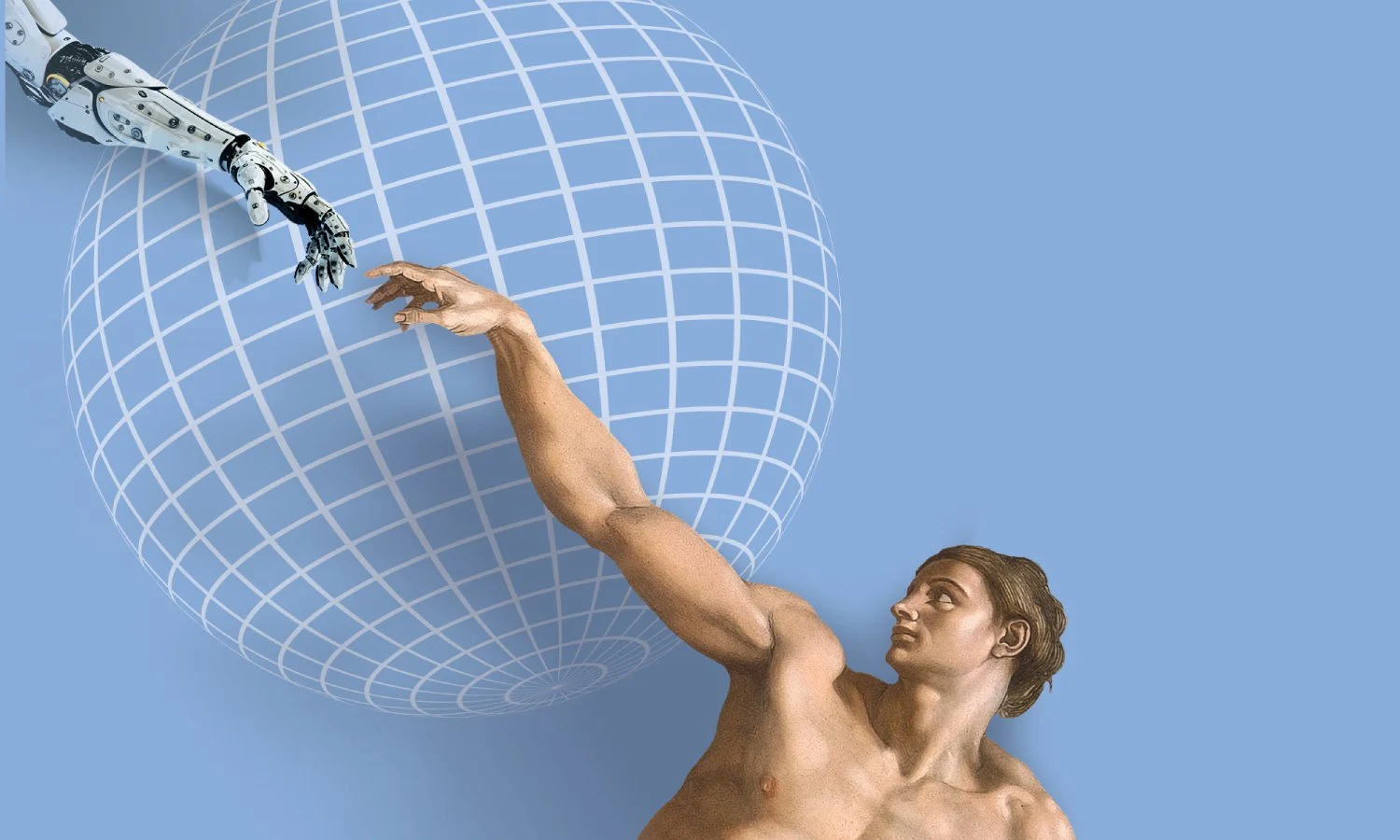
The dawning of the age of artificial intelligence (AI) has sparked great excitement. The prospect of turbocharging productivity, boosting research, overcoming time and human limitations are just some of the trumpeted blessings of AI. It is undeniable that AI is now an indispensable part of modern life. Not just in manufacturing, medicine, the military, education and economics, but also in everyday life. Algorithms are embedded in objects we use daily. The smartphone, that handy AI machine in our pocket, plugs us into the digital ecosystem that dictates how we live today.
Beyond the hype surrounding AI are serious concerns raised about a future dominated by superintelligent machines. Serious thinkers in science, technology and philosophy warn of the possibility of machines surpassing human intellectual capacity one day, leading to the dystopic scenario of people either being subjugated or made redundant altogether. What was once the stuff of sci-fi movies may well become a fearful reality.
Even if we regard these warnings as alarmist and overblown, one cannot ignore AI’s disruptive implications. Particularly, the societal impact of increasing reliance on AI systems and the ceding of control to them. The ramifications are many and far-reaching. For our purposes, we will focus on the impact of AI on the question of what it means to be human. In this regard, the Christian understanding of human beings made in the image of God (imago Dei) offers guidance on navigating life in our algorithm-driven world.
Foundational to the biblical doctrine of “the human person is the affirmation that God “created man in his own image” (Genesis 1:26-28). What constitutes the imago Dei is not explained in the Genesis passage, but the question of its meaning has long exercised Christians. Interpretations of the imago Dei in Christian tradition fall broadly into three categories: substantive, functional or relational.
Substantive interpretations regard the divine image as a property or properties that all humans possess intrinsically. Functional approaches locate the image in what humans do, specifically in exercising stewardship over the created order. And relational interpretations understand the image of God in the way humans relate to God and with one another.
With this in mind, we shall attempt, however briefly, to analyse AI technology from the standpoint of the imago Dei.
The imago Dei as intrinsic God-relatedness
A human person is in God’s image in the sense of being constitutively God-related. As the image of a person in the mirror is dependent on the person standing in front of it, so humans in God’s image are inescapably related to God. We are only because God is.
As creatures, humans stand on the creation side of the ontological divide between Creator and his creation. But we are also self-aware creatures endowed with the capacity to relate to God spiritually. It is this capacity for a human-God relationship that marks us out as unique and invests us with dignity.
As creatures, humans stand on the creation side of the ontological divide between Creator and his creation. But we are also self-aware creatures endowed with the capacity to relate to God spiritually. It is this capacity for a human-God relationship that marks us out as unique and invests us with dignity.
Humanity’s uniqueness, however, is increasingly being challenged by AI technology. The emergence of AI machines that not only mimic but outperform human intelligence threatens to erode the distinction between the human person and machine. With machine learning gathering pace, it is argued that AI would soon gain consciousness and become sentient. For techno-enthusiasts, the prospect of seeing synthetic brains animating human-looking robots is a delicious one.
To speak of AI becoming anything is to speak metaphorically. What capacity it has is but an expression of the power and intention of the people behind it. As such, the desire to create sentient beings, albeit of a robotic kind, speaks to human hubris in seeking to play God. Just as God made humans in his image, so humans now create the machine in their own image.
As machines become increasingly like humans, humans ironically become increasingly like machines. Such dehumanising of people is joined by the idolatrous deification of the machine. We construct a powerful AI machine and then genuflect before it, looking to it for moral guidance, wisdom, companionship and salvation. Humans behaving like machines, and machines being treated like a deity. We are a long way from the dignity of our God- related humanity.
Humans in communion and relationship
God created man in his image, “male and female he created them” (Genesis 1:27). The divine image is seen in the male- female polarity. Humans are relational beings, made to live in communion with God and with each other. The need and ability to relate with other people is integral to being human in God’s image.
One of the blessings of our hyperconnected age is the ability to connect electronically with people everywhere. Yet the same digital technology that allows us to interact in real time across continents is also the means by which people cut themselves off from others. We may be hyperconnected digitally, but as a race we are increasingly disconnected socially.
We may be hyperconnected digitally, but as a race we are increasingly disconnected socially.
This is exacerbated by the pseudo-intimacy found on social media platforms. Online “friends” of celebrities often feel like they know them personally, more than the flesh-and-blood individuals next to them at home. There seems to be greater affinity to digital personas than flesh-and- blood persons.
The same phenomenon is there when we call a company hotline to speak to someone, only to be directed to a chatbot instead. While we gripe about this, interestingly some actually welcome this.
As AI grows in sophistication, not a few people are finding companionship, counsel and solace if not love with chatbots. In some cases, the algorithmic simulation of romance has led some to “marry” their chatbot partners! Such objectophilia is a sad commentary of our times.

Sin’s distortion of the imago Dei
Along with the instruction to “be fruitful and multiply”, God gave man the mandate to “subdue” the earth and exercise dominion over all living creatures (Genesis 1:28). This is a call to exercise stewardship, to deputise for the Creator in continuing his creative work of bringing cosmos out of chaos.
Humans thus create tools and innovate systems aimed at realising God’s purposes for the world. Insofar as AI systems contribute to human well-being and the betterment of God’s world, they are to be celebrated as a manifestation of the creativity entailed in the imago Dei.
The Fall in Eden however led to the disfiguring of the divine image. While humans still bear the image of God after sin entered the world, their ability to image God properly has been compromised. Sin has infected the way humans relate to God and each other, and in the exercising of their God-given responsibility.
AI systems are human products that bear the imprimatur of their human creators. And given the fact of human sinfulness, are we surprised to find creators—and consumers—of digital technologies using them for selfish and nefarious purposes?
The AI tools that deliver efficient healthcare services and improve infrastructure services are also used to are also used to produce deepfakes, amplify hate and foster political unrest. People’s needs and vulnerabilities are codified and manipulated, often unknown to them. Big Tech mines, manages, manipulates and monopolises huge amounts of data to predict and shape conduct with the aim of filling their coffers.