It has often been said that there are too many denominations in Christianity, which is overly confusing for those without and perhaps also for those within. It should be noted, however, that denominationalism is not unique to Christianity since it is an equally common phenomenon evident in all the major world religions.
The dictionary definition of the word renders denomination as “a particular religious group which has slightly different beliefs from other groups within the same faith.”1 It is perhaps important to make a distinction between denominations and cults;2 where the former is understood as a branch that may have varying emphases and practices, yet are all aligned with the major tenets of doctrine of the faith, whilst the latter holds on to the view(s) of particular charismatic leaders that is (are) at variance and regarded as apostate (unorthodox or heterodox). In short, a Christian denomination is one that holds on to the major tenets of the Christian faith, as articulated by such as the Nicene Creed or the Apostles’ Creed, but exhibits a particular or unique emphases in polity and practices.
Major schisms
Historically there have been a few major schisms that have splintered the Church, giving rise to various denominations. We are perhaps more familiar with the denominations such as Anglicanism, Lutheranism and Presbyterianism which arose as a result of the Protestant Reformation, catalysed by Martin Luther’s posting of the ninety-five theses at the door of the castle church in Wittenburg in 1517. It should be noted that Luther’s post was not intended to fracture the Roman Catholic Church but instead marked his desire to bring attention to the ecclesial authorities including the Pope, the need to return to the Scriptures especially regarding the practice of the sale of indulgences (a practice that was contrary to the counsel of the Scriptures). Not unlike human institutions, the medieval Church had become increasingly bloated with its own power and wealth. The moral laxity of the clergy, the growing general apathy towards the Scriptures, a stifling obduracy to traditionalism and a sense of impassivity to the work of the Holy Spirit sparked separate movements across Europe.
It should be noted that Luther’s post was not intended to fracture the Roman Catholic Church but instead marked his desire to bring attention to the ecclesial authorities including the Pope, the need to return to the Scriptures especially regarding the practice of the sale of indulgences (a practice that was contrary to the counsel of the Scriptures).
Hence the Reformation should not be perceived as one monolithic movement, but instead multiple reform movements which emerged in different geographical contexts with quite differing foci, albeit as a response to the deterioration within the Roman Catholic Church. In response to pomp and pageantry of Roman Catholic practices, the reformers’ emphasis on the five “solas”3—sola Scriptura, sola gratia, sola fide, solus Christus, and soli Deo gloria—became foundational for understanding the gospel and particularly the doctrine of salvation.
Church historians have classified the Reformation in two movements—the first is the Magisterial Reformation, where “mainstream reformers worked closely with the state and city officials (thus the term “magisterial”), seeing the Reformation as involving both church and state.”4 Alongside this, is what has been termed as Radical Reformation, where the protagonists of these movements felt that the magisterial reformers were too restrained and had not gone far enough in bringing about a more thorough reformation in returning the Christian faith to its biblical roots. They were referred to as “Anabaptists” for their rejection of paedobaptism and emphasis on re-baptism.
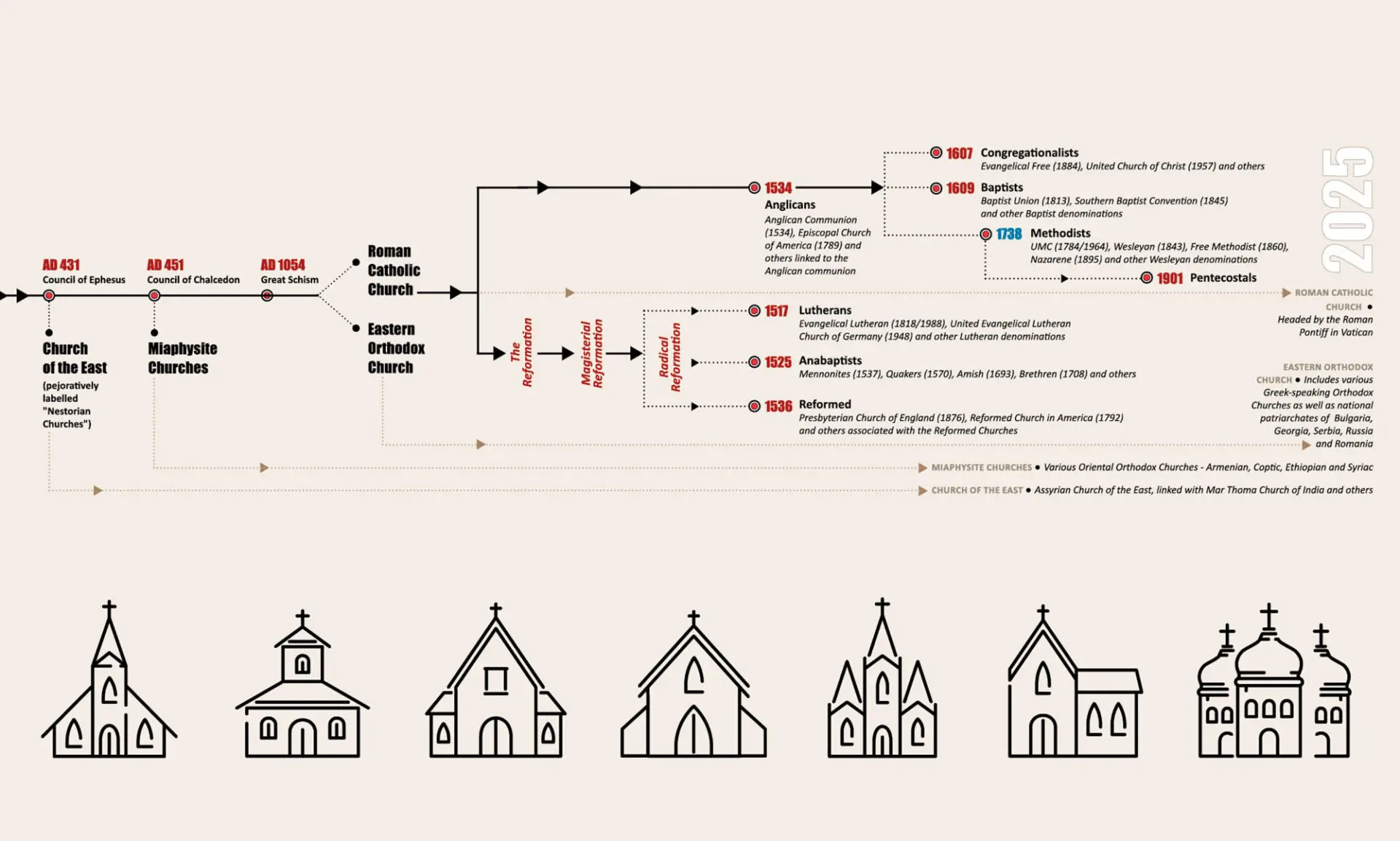
While we often locate the development of denominations primarily to the Protestant Reformation, there are perhaps three other points in the history of the Church that have resulted in splintering the Church. At the Council of Ephesus, 431 AD, more than theological discussions/debates, it was political manoeuvrings that resulted in the “establishment” of the Church of the East, an oft misrepresented and yet missional Syriac-speaking ecclesial community that brought the Gospel to India as well as Tang China in the 7th century.5 A second break occurred when the debates on the nature and person of Jesus Christ at the Council of Chalcedon resulted in what we refer to as the non-Chalcedonian churches, that is, the Miaphysite Churches.6 The most (in)famous split is perhaps the division between the Latin-speaking churches in the West (of the Mediterranean, under the Pope) and the Greek-speaking churches in the East (under the Patriarchs, notably the Patriarch of Constantinople) over the filioque7 controversy as well as differences over papal/patriarchal primacy, polity and practices (such as the dates of Easter and clerical celibacy)!8
Let me explain this visually with a simplified timeline (see the image on top).
United but unique
In John 17, Jesus prayed for his disciples, that they may be one. We understand oneness as being of “one hope, one Lord, one faith, one baptism, one God” (Ephesians 4). And this is perhaps why denominations cause us to pause and question our oneness. We should note that oneness, however, does not negate our uniqueness; and that unity is NOT uniformity. Insofar as a church upholds the Word of God and the theological dogmas articulated in the historic creeds, both of which helpfully guard against theological excesses and errors, there is room for diversity (including structural and cultural variations), wherein Paul employed the analogy of the body in highlighting that “there are many members, but one body”. For Paul, the mark of Christian unity is when the different parts of the body exhibit the “more excellent way”—that of Christian love, in the passage of 1 Corinthians 13.
We should note that oneness, however, does not negate our uniqueness; and that unity is NOT uniformity.
Practically, in our local context, this “more excellent way” is demonstrably enacted in the way the four denominations (Anglicans, Lutherans, Methodists and Presbyterians – the 4Ds) have collaborated especially in the Chinese churches. Another notable example is the establishment of a union college, Trinity Theological College, for the theological training of pastors and church workers, not only for the founding churches but also for the greater Christian community in Singapore. Such collaborations and cooperations exemplify the body analogy of Paul in 1 Corinthians and put into action the prayer of Jesus— “that they may be one”.
1 Collins Dictionary – see https://www.collinsdictionary.com/dictionary/english/denomination
2 It should be noted that the word “cult” in its original context does not necessarily have a negative connotation as it is used today. The Latin word “cultus” references the adoration and care given to the god(s); specifically, it is “to tend, to take care of”, from which we derive the word “cultivate”. The current usage tends towards a more negative connotation, one which highlights the doctrinal difference between what is understood as “mainline” and “orthodox” and that of the cult, which is regarded as heterodox.
3 See https://www.logos.com/grow/5-solas-reformation/
4 Robert Solomon, The Reformation – the thoughts, lives and legacy of the Reformers, (Singapore: Armour, 2017), 31.
5 Samuel Moffett, A History of Christianity in Asia Vol 1, (Maryknoll, NY: Orbis Books, 1998) 2nd ed, 168-184
6 Mark Noll, David Komline, and Han-luen Kantzer Komline, Turning Points – Decisive Moments in the History of Christianity, (Grand Rapids, MI: Baker Academic, 2022) 4th ed, 46-64.
7 A seemingly small and extremely divisive addition to the Nicene-Constantinopolitan Creed, the Latin word filioque, which means “and from the Son,” was included in the creed without consultation with the Greek-speaking churches in the East. This further fuelled the East-West power politics.
8 Mark Noll, David Komline, and Han-luen Kantzer Komline Turning Points, 107-127.
Rev Dr Andrew Peh is a lecturer in mission and world religions at Trinity Theological College (TTC). He is an alumnus of TTC as well as Asbury Theological Seminary in Wilmore, Kentucky, USA. He is ordained as a diaconal minister in the Chinese Annual Conference of The Methodist Church in Singapore and is attached to Bukit Panjang Methodist Church. His research interests are in colonial missions history of Southeast Asia (particularly Singapore) and the missions history of East Asia (particularly Japanese Christianity).