
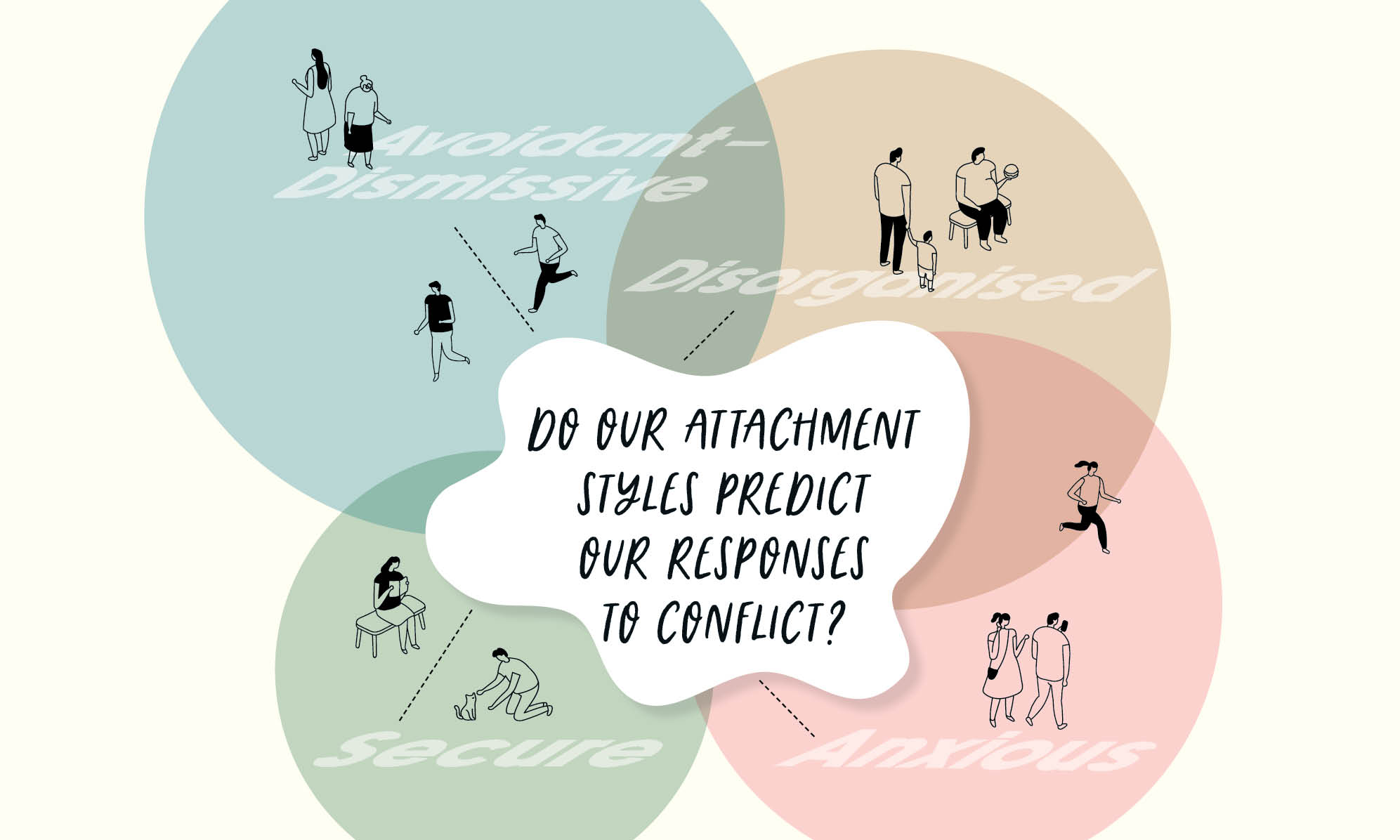
Several psychological theories have been developed to explain how human beings behave, including how they handle conflict. One theory is that human interaction is influenced by unconscious emotions and impulses. Another is that our beliefs and assumptions about people guide how we relate to them. In recent times, Attachment Theory, first introduced by Dr John Bowlby in the 1960s, has been gaining attention. This theory seeks to provide understanding of how the frequency and intensity of interpersonal conflicts that individuals experience may be influenced by their attachment type.
Attachment Theory proposes that the quality of care and connection between a mother and her child lays the foundation for how the child feels and thinks about themselves and about others. As individuals’ early experiences shape how they see others and themselves, these experiences have an impact not only in infanthood but may (more on this caveat later) affect them into adulthood.
The four attachment styles
Children who are cared for and loved in a consistent manner feel that the world as they experience it is a safe place. They form Secure Attachment.
In contrast, children raised in an inconsistent and harsh manner may see the world as a fearful place. Their fear and distrust leads to Insecure Attachment. Mary Ainsworth, and later Main and Hesse, expanded on Dr Bowlby’s work and identified three subtypes of Insecure Attachment.
First, there is the Avoidant-Dismissive Attachment subtype where individuals find it hard to trust others and therefore avoid close or long-term commitment to relationships. They tend to see themselves as perhaps superior to others and can be emotionally distant.
The second subtype is Anxious (also known as Ambivalent/Preoccupied) Attachment. These individuals experience conflicting feelings of wanting to be close to others and sometimes act in a clingy fashion while at other times, perhaps anticipating rejection, they are cold and rejecting toward others.
Finally, there is the Disorganised Attachment subtype whose response to relationships is a mixture of the other subtypes. This presents a confusing toxic mix that makes these individuals difficult to get along with. These individuals remain reclusive, sometimes acting aggressively and at other times withdrawing out of fear of others.
Attachment types can influence how often an individual encounters conflict and how intense it becomes. People with Secure Attachment tend to experience fewer conflicts; if and when disagreements do occur, they are generally better at regulating their emotions, allowing for more harmonious outcomes.
Contrast this with the Avoidant-Dismissive, Anxious and Disorganised types, whose interpersonal relationships are often stormier as they may withdraw, escalate or send mixed signals during conflict.
To illustrate the different responses to conflict, take a common scenario: A husband repeatedly misses dinner and comes home late without informing his wife earlier. The wife feels upset. What happens when he walks through the front door one evening is revealing.
A wife with Secure Attachment is more likely to say: “I worry when you don’t call or text when you come home late. Can we talk about this?” By contrast, a wife with Insecure Avoidant-Dismissive Attachment may avoid talking about how she feels but withdraw emotionally. The Anxious individual typically takes the bull by the horns, hoping for a quick resolution that will satisfy her strong need for reassurance and reconnection with her partner. She may say: “I was worried when you didn’t call or text. Do you still care about me—are we okay?” Finally, a Disorganised individual’s attachment response typically involves sending mixed signals, e.g. the wife may confront her spouse angrily with, “Why don’t you call or WhatsApp me when you’re not coming home for dinner?” Midway, she may suddenly shut down or act like she does not care, saying, “Never mind … you just keep on doing whatever you want, I don’t care.”
In a nutshell, Attachment Theory suggests that Secure Attachment leads to the best outcomes in interpersonal relationships and conflicts. Let me now draw a few points about the implications for healthy personal and social development.
The critical early years of childhood
The first is that the early years are critical in the formation of a person’s personality and social outlook. What happens in a child’s early years bears fruit throughout life. This is similar to children given an impoverished diet—they not only fall short of their physical potential but also may have health challenges all through life. Children with Secure Attachment tend to be not only happier but also more emotionally resilient, self-confident and able to get along with others.
My second point is parents and caregivers play an indispensable role during the formative years. Parents are responsible for providing the basic needs to sustain life—food, shelter and protection from harm. To thrive, children also need to be loved, valued and taught. Teaching involves setting and enforcing rules—while children naturally dislike being disciplined or denied what they want, they are likely to accept it within the broad context of a loving relationship. Parents, remember that you are vital in training up your children in the way they should go so that even when they are old, they will not depart from it (Proverbs 22:6). Begin early to build a strong biblical foundation for your child’s moral and character growth.
A third point often missed, and this brings me back to the caveat “may” mentioned earlier, is that though we may go through unfortunate early experiences, the negative effects can be mitigated by later positive experiences. Helping children and teenagers who have experienced adverse experiences like abuse usually involves surrounding them with positive life affirming experiences.
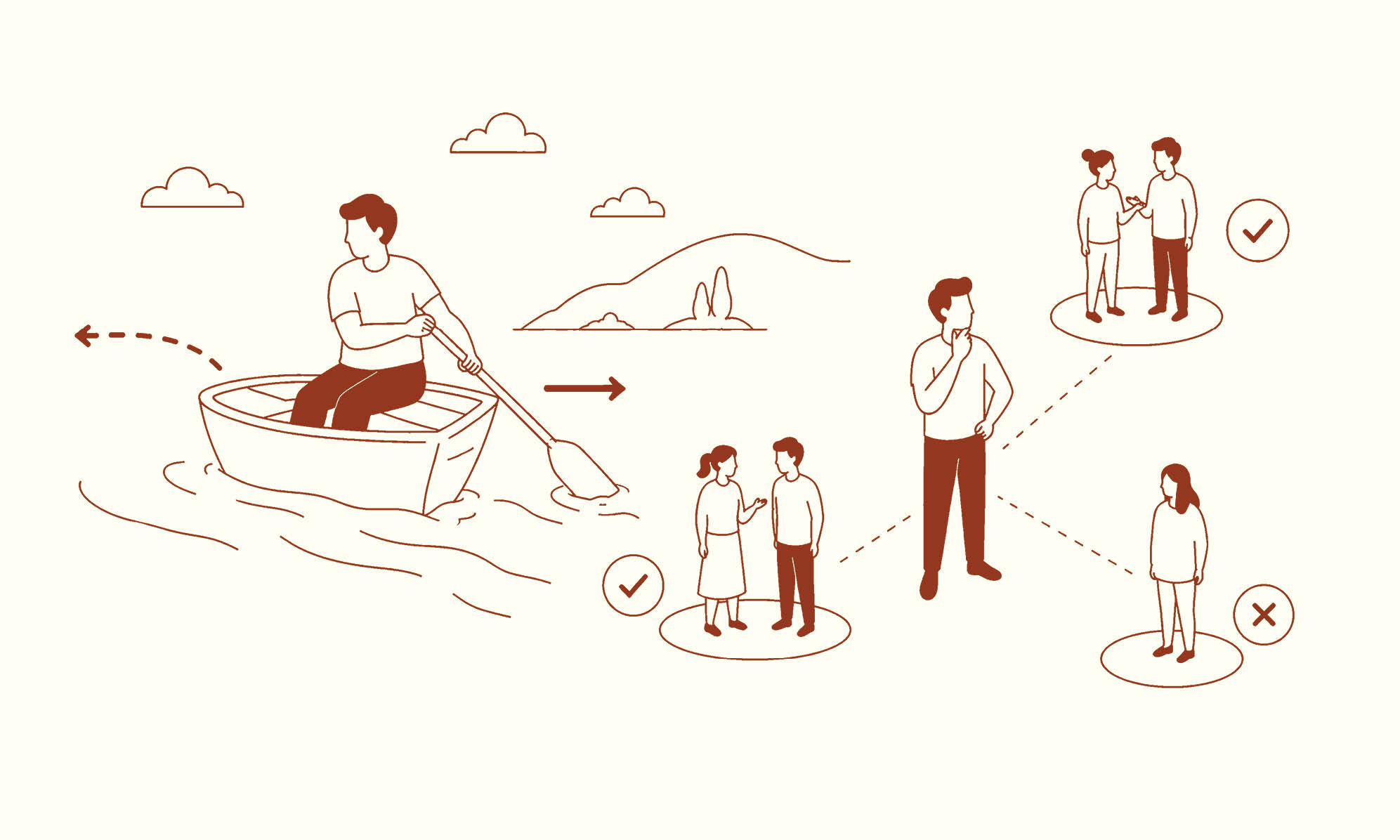
Also, if we become aware of our negative tendencies that were shaped by childhood experiences, we can learn to overcome them. It is like steering a boat—if it tends to move towards the left, we compensate by pulling more in the opposite direction. Similarly, if we see in ourselves a pattern of not trusting others and thinking the worst of them, we can learn to discern better who we can trust and practise skills to develop trust in these people. Rather than simply seeing ourselves as products of what earlier generations have done to us, we can and should recover a sense of personal agency or self-control.
It is like steering a boat—if it tends to move towards the left, we compensate by pulling more in the opposite direction. Similarly, if we see in ourselves a pattern of not trusting others and thinking the worst of them, we can learn to discern better who we can trust and practise skills to develop trust in these people.
Attachment styles and faith
This brings me to the intersection between attachment styles and faith. Some may wonder if Christians, having gone through spiritual rebirth, can overcome the negative experiences of their earlier years? Can close attachment to a Heavenly Father compensate for or even replace a lack of love from earthly parents?
Based on a few interactions with clients, I suspect that while spiritual rebirth, together with the power of the Holy Spirit, can deeply transform a believer, a certain degree of personal maturity is needed to fully overcome negative influences from the past. By maturity, I mean more than just chronological—it encompasses emotional and psychological stability too.
With more mature clients showing Insecure Attachment, learning to connect with and depend on an all-powerful, ever-present and unconditionally loving Father can offer an empowering attachment that is nothing short of life- and perspective-changing. The Bible tells of God as the perfect Secure Attachment figure—our strong and dependable refuge (Psalm 46:1), the Good Shepherd who protects and leads us to nourishing green pastures (Psalm 23) and our Heavenly Father (1 John 3:1-3).
For those of us who have been blessed to grow up with Secure Attachment and also experience God’s grace, may we show the same grace to others by being less critical, more forgiving and kinder to those less fortunate. Through this, we could help others find the best source of security in the loving arms of our Heavenly Father.