When dementia slowly takes a mother away, one daughter discovers that faithful caregiving means seeing beyond behaviour—and trusting that God holds what memory cannot.
快点,我现在要去嫲的家! (“Quickly, I have to go to Ma’s place now!”)
My mother exclaimed with increasing agitation in the wee hours of the night. My exhausted father and their new live-in helper stood by, explaining it was not the right time to go out. Everyone was getting worked up.
My mother only calmed down when they distracted her with a drink. I watched this unfold from the home closed-circuit television app, feeling anguished and guilty that I could not help them remotely.
My mother, in her mid-70s, lives with dementia. It has been 10 years since she was diagnosed. For my father, it has been several years of caregiving as he grapples with her gradual loss of self-care abilities and daily functioning. There is considerable impact on my father’s well-being and my own faith journey. Coupled with my father’s own frailty, this poses challenges to our resilience and trust in God.
Early days and broken-heartedness
The Psalmist reminds us that God “is near to the broken-hearted and saves the crushed in spirit” (Psalm 34:18). Those words became deeply personal to me on the day the geriatrician confirmed my mother’s diagnosis. Despite my work experience as a counsellor and knowledge of how to support her, I still felt deep sorrow and fear. And yet, I can vividly recall how I felt God’s comforting presence. I was crying silently while cradling and nursing my son, who was about four months old. He unlatched, looked up at me with big, caring eyes—as if God himself were meeting me and comforting me through that gaze. I felt saturated with a deep sense of peace.
Renewed awareness of my mother’s identity in God
Whenever my father encountered hiccups in his daily interactions with my mother, I would try to “fix” her behaviour by problem-solving and suggesting communication strategies. The turning point came one day when my mother lamented aloud, “我也不想这样的“ (“I also don’t want to become like this”). It was the first time she had ever voiced how she felt, and it stopped me in my tracks.
The turning point came one day when my mother lamented aloud, “我也不想这样的” (“I also don’t want to become like this”). It was the first time she had ever voiced how she felt, and it stopped me in my tracks.
I was reminded of my mother’s personhood and identity in God. The Psalmist writes that God “knitted” each of us together in our mother’s womb, and that we are “fearfully and wonderfully made” (Psalm 139:13–14). We had been so focused on managing her symptoms that we had overlooked her innermost feelings and thoughts. Her progressive loss of cognitive and executive functioning such as reduced attention span, short- term memory lapses and increasing dependency, are major stressors. These often cloud our understanding of her feelings, thoughts and needs.
With a renewed awareness of my mother’s personhood in God, I began to see the world through her lens instead. I could now empathise with her expressions of anxiety and fear in new places. Her frantic search for her own mother during night-time disorientation had perhaps been an unmet need for familiarity when the new live-in helper arrived. Seeing her as a child of God—fully known and fully loved by him—continually guides me to sojourn alongside her, and to stay present in her world. This is a temporary abode, after all, until she reaches her permanent home in heaven. Importantly, sojourning is about reflecting on and attuning to her ways of being, and to the feelings that may be overshadowed by her behaviour.
My mother’s roles and beliefs are intact
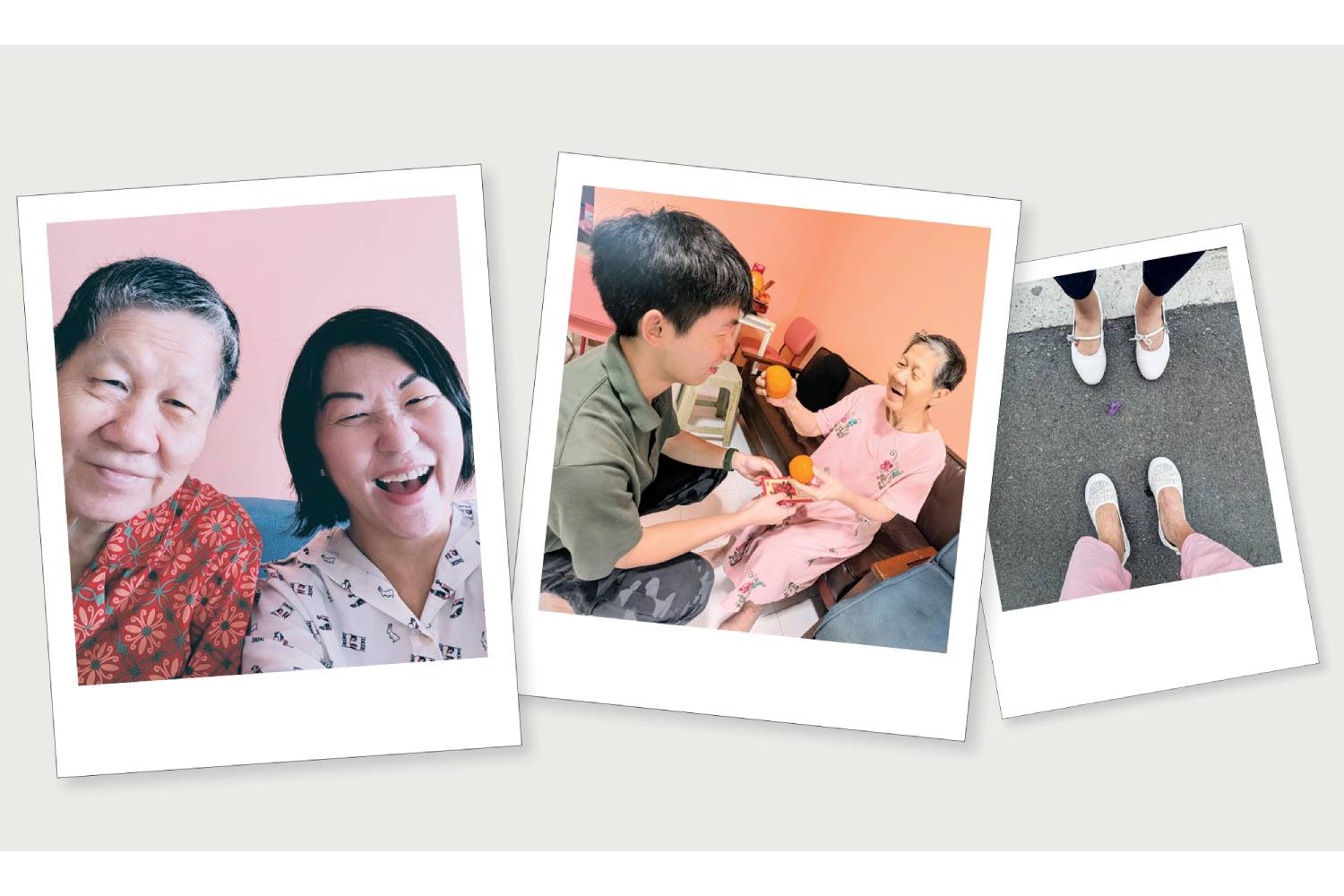
I now appreciate anew how my mother continues to care as a wife, mother and grandmother. While somewhat sedated due to mood-stabilising medication, she opens her eyes instantly when I call her “Mummy”, even from a distance. She looks forward to my father’s visits at the nursing home.
Spending time with her grandchildren also brings out the elusive smiles and sustained eye contact of delight that I had not seen spontaneously for a year or two since her condition deteriorated.
Amazingly, while my mother struggles to recall names and follow instructions, she remembers the name of Jesus and affirms her belief in God with some prompting. The Psalmist’s invitation to “taste and see that the Lord is good” (Psalm 34:8) feels fittingly embodied in how she still relishes God’s creation—the colourful flowers and plants she seeks out and reaches for on her daily walks. Her faith, it seems, runs deeper than memory.
The Psalmist’s invitation to “taste and see that the Lord is good” (Psalm 34:8) feels fittingly embodied in how she still relishes God’s creation—the colourful flowers and plants she seeks out and reaches for on her daily walks. Her faith, it seems, runs deeper than memory.
God’s faithfulness
In hindsight, we have experienced much kindness and compassion throughout the spectrum of dementia care services. God has provided my mother with kind geriatricians who were my former colleagues from decades ago, and who remain supportive even outside office hours. At the nursing home, I had serendipitous encounters with support staff who were friends from university and past work. It is comforting to know that God—all-present and all-knowing—is watching over my mother wherever she is.
Lamentations 3:22–23 has become an anchor for me in moments of dwindling faith: “The steadfast love of the Lord never ceases; his mercies never come to an end; they are new every morning; great is your faithfulness.” Last year, when I had to initiate the process for my mother’s admission to the nursing home, it was the most painful and difficult chapter of my adulthood: learning to let go, to try professional care and to be the one reassuring my father that he had done his best as her main caregiver.

One morning, wrestling with guilt and grief, I glanced towards my childhood home and spotted a huge rainbow. It was extraordinary—appearing right before a heavy storm, arching long and wide, covering part of the route to the nursing home and ending at a building with a cross-like pattern. It felt like a quiet, unmistakable assurance from God.
Because of her short-term memory lapses, my mother wakes each day to a new reality—a fresh beginning, new mercies. While that is disorientating for her, I hold on to the truth that God is the one constant. He is the same yesterday, today and tomorrow. And he is right there with my mother.