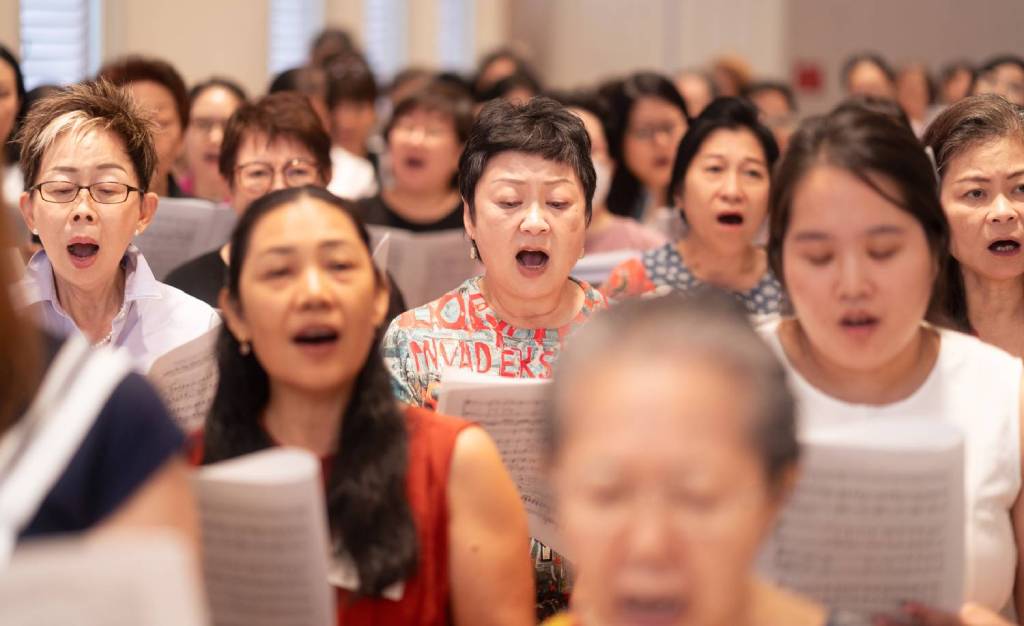

Worship is a space where we dialogue with God. The language of songs, Scripture and sermon are woven into a cohesive whole—so that anyone who enters that space can relate, be engaged, actively participate and encounter God.
So who is in this space? People from all walks of life. A husband and wife. Siblings. Close friends. Some come carrying relationships that are clear and named. Others carry relationships that feel uncertain, are still unfolding or perhaps difficult to define—including what many today call a”situationship”—and wonder if they belong here too.
What does this space say about our relationships? When we dialogue with God, he desires honesty. We bring to him who we truly are, not who we think we should be. And we cannot hide even if we tried. Psalm 139:1–4 reminds us of this so tenderly: God knows us inside out, in every unspoken longing and every relationship, named or unnamed. The “Collect for Purity” echoes this beautifully: in worship, we come before the One “unto whom all hearts are open, all desires known, and from whom no secrets are hid.”1
Many hymns speak of a God of mercy who accepts and embraces us as we are. Fred Pratt Green’s “God Is Here” pauses us at exactly this point. The second stanza reminds us that wherever we gather—whatever symbols surround us—grace is the constant:
Here are symbols to remind us of our lifelong need of grace … here, in newness and renewal, God the Spirit comes to each.2
Sylvia Dunstan’s “All Who Hunger” extends this further, calling out to those who yearn for days of fullness, promising they will never be strangers at the table.3 That longing for fullness to be known, named and held speaks tenderly into the emotional reality of human relationships, and situationships in particular.
This dialogue happens throughout the entire act of worship. In the Call to Worship, we are not summoned as people who have resolved every question about our lives, but as people who are welcomed as we are, uncertain and all. In Confession, that honest, corporate moment where we name the gap between who we are and who we long to be—we discover that grace meets us precisely there in the gap. In the Sermon, when preaching is brave enough to name the world that people actually live in and not the world we assume we inhabit, something unlocks. And in Song, a hymn can carry a longing we have not yet found words for. Suddenly, the person sitting alone with their imperfect relationship realises they are not as alone as they thought.
Perhaps it is time to take stock. To look honestly at our liturgies—the language we use, the assumptions, imagination and theology we carry, the realities we name and leave unnamed. In song—whether repertoire, congregational, choral or solo—we need to ask: What are we singing and speaking about? And equally, what are we not naming at all? What stories are being told in our worship, and whose stories are being left out? The audit itself is an act of pastoral care.
Worship invites the congregation into active participation—in song, in prayer, in silence. When planners become sensitive to the full range of human experience that people carry into that space, something shifts. Those with settled answers and those still discerning can listen together, bring their questions together and learn to hold one another’s realities with grace rather than avoidance. That is not just good liturgy. That is the body of Christ functioning as it should.
But worship cannot end at the door. If God’s Spirit comes to each—the couple, the siblings, the friends and yes, the person navigating an uncertain relationship—meeting us honestly and graciously in the midst of our brokenness and uncertainty, then we who gather are being formed to do the same. The question for the worship team and pastoral team is not simply whether the songs are singable or the sermon well-crafted. It is whether the person navigating complications or uncertainties in their relationships—perhaps feeling ashamed, wondering if their life is “too complicated” for church—feels genuinely seen in that space.
And the question for the rest of us—families, friends, fellow congregants—is whether we carry that grace out with us. Into the family dinner where we press our adult children about “what exactly is going on” with someone they care about. Into the friendships where we often rush to give answers instead of simply sitting with someone in their uncertainty. And sometimes, with gentleness and honesty, into the harder conversation in situationships—whether it is time to name the relationship, to commit or perhaps to let go.