

People do not become homeless because they run out of resources—they become homeless because they run out of relationships. Abraham Yeo of Homeless Hearts of Singapore (HHOS) shares the stories behind the statistics, and a call for the Church to see, and love, the homeless among us.
When you think of the homeless in Singapore, do you picture elderly, unshaven men on cold benches, lone aunties sitting quietly in fast-food restaurants, or families camping at East Coast Park on a weekday night?
It may surprise you that there are young adults and teens who are homeless in Singapore too. Some real-life examples that have happened right under our noses: a postgraduate student doing tutorial homework on a dimly-lit void deck table; a young man on his e-bike doing food delivery after a night at a budget hostel with 18 others; a single mother with an infant, jobless after taking too many emergency childcare leave days.
Official data vs. reality
Homeless Hearts of Singapore (HHOS) is one of a handful of organisations tackling homelessness here, working with government bodies, churches and transition shelters. Our approach is relational—we befriend rough sleepers and understand their plight first.
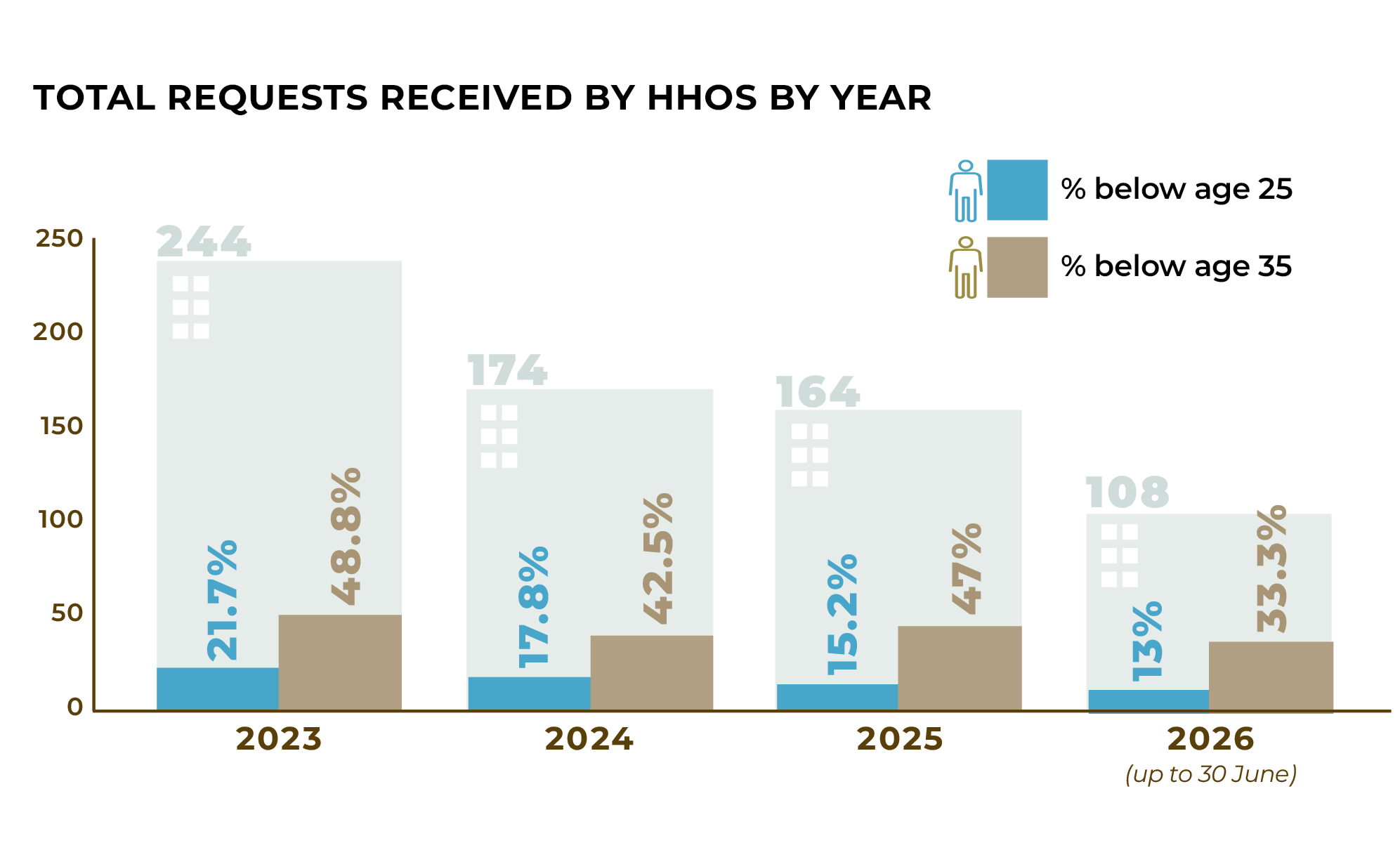
In 2025, 47 per cent of the 164 official requests for help that HHOS received (excluding foreigners’ requests) were from persons aged below 35 years old. From 2023 to 2025, almost 20 per cent (on average) were below 25. In other words, a significant proportion of our requests come from fairly young people.
The Ministry of Social and Family Development (MSF) released a report on rough sleepers in July 2025.1 The report noted that “more than half” of the 496 rough sleepers counted were “over the age of 50” while “36 per cent were between 31 and 50, and 6 per cent were aged 30 and younger.”
The MSF report might suggest that young rough sleepers make up a small proportion of the total, but in HHOS’ work, we see a different picture. It is important to note that MSF’s statistics are based on street counts, which only capture rough sleepers visible in public; it does not take into account the sheltered homeless couch- surfing with friends or relatives, or those burning through savings in hostels, who are unable to live in their actual home for various reasons.
Broken homes and unexpected tragedies lead to homeless youths
Homelessness among youths is often rooted in family breakdowns, often due to abuse, conflict and estrangement. These can be more damaging than financial hardship, because they trigger cycles of mental and social difficulty that sever people from their support networks and affect their ability to work.
Youths are especially vulnerable due to financial instability and lower educational attainments, making them susceptible to exploitation and crime. Many are “aged out” of institutional homes without healthy families to fall back on.
Youths are especially vulnerable due to financial instability and lower educational attainments, making them susceptible to exploitation and crime. Many are “aged out” of institutional homes without healthy families to fall back on.
Escalating rents also make housing solutions in the open market practically unattainable. Some are too young for public rental flats or have too little CPF for a BTO. Even full-time work often is insufficient—daily wages barely cover hostel fees and food, let alone emergencies. With the rise of “sugar dating” apps, many homeless women even resort to these solutions to make ends meet.
In short, broken families lead to broken homes. Even educated, middle-class families can fall into homelessness when tragedy strikes.
Let me tell you three true stories.
Natasha, 25, lived in a transition shelter with her father previously
Natasha appealed to HHOS in November 2023, facing eviction from their flat in Geylang with her father, who had been physically and cognitively impaired by a stroke in 2015. Her mother had quit a high-paying job to care for him but later died of cancer in 2019. With only A-levels, Natasha worked odd jobs—kitchen assistant, tuition teacher—to support them both, after being retrenched from her sales job.
“I never shared with my father how difficult it was for me to make ends meet. It was a coin flip on whether we could afford rent each month,” she said.
Upon their eviction, I connected her with a pastor from their previous church. A one-time $400 relief was provided though further help required reapplying with additional paperwork.
“The process of having to seek financial aid was embarrassing for me, as I felt like I had failed my dad as his daughter,” Natasha said. “It was even more stressful to deal with such scrutiny that I considered going hungry instead. However, I could not do so as I needed to consider my dad’s wellbeing.”
The loss of her dignity, her friends, and even her family photos that their landlord threw away, was almost too much to bear. “Every part of my life had been about checks and balances. I had to act like an ‘ordinary’ carefree young adult in front of my friends whom I could not trust with the truth.” One friend even told her to go to temples to beg for food, but she refused because of her faith.
However, the Lord was with her. One of our HHOS volunteers, a Christian sister, opened up her own one-room flat for Natasha and her father, while Natasha’s social worker secured shelter and public housing for Natasha and her father.
Natasha found a loving community through our “Abba’s House” gatherings, where my wife and I invite homeless (or formerly homeless) friends to our home for fellowship and meals. Another Christian sister even bought brand new work clothes and glasses for Natasha.
“After losing all my friends and dignity, I had nothing else to lose and just went there after some wrestling with the Lord. It was through being in that environment that I saw what it was like to have love within the community.
There was no judgement or comparison regarding how much or how little you have. I had never experienced something so pure before in my life. The atmosphere was one of kindness and is something I hope I can give to others in the same way they have given to me.”
Today, Natasha is an operations and facilities manager, living with her father in a rental flat. She currently worships at 3:16 Church.

Erikson, 33, rough sleeping since 2017
Erikson (not his real name), whom I’ve known since 2018, was kicked out of his home by his brother after an argument. The youngest of five siblings, his largely absent father died in 2016. His mother’s unclear marital status meant she never secured her own flat, and his grandparents were his key parental figures growing up. He told me, “I’ve longed for a physical place of my own where I can be myself, where I can be free,” away from the constant tension and need to “tiptoe” around family.
In 2017, Erikson and his partner Josie (not her real name) went to the streets. A pastor and his wife took them in for three months. Knowing they’d eventually have to leave, Erikson and Josie got involved with a “secret society”, which gave them a sense of belonging—until the group drifted apart. Through an old friend, he attended a church in 2019, where I met him and encouraged him to get baptised, which he did.
During Covid-19, Erikson cycled through transition shelters and rented rooms, returning to the streets each time his savings ran out. He has tried furthering his education in game design and online marketing, but struggled through the course, saying: “What’s the purpose of studying for this?”
Despite receiving the Halimah Yacob Youth Award and applying to ITE four times, each attempt lasted only a semester. “Without a stable place to stay, it’s hard to do my work and assignments.”
He recognises the help he’s received over the years but says that he “struggles to make sense of these very different standards of living and societal expectations”.
“Whether we’re surviving in the jungle, surviving at home or surviving in Sentosa— it’s all the same. We’re all surviving, really. Some think if you have enough money, then you’re living. But the truth is, we are all trying to survive.”
Erikson is still rough sleeping today, but meets me regularly for Bible study.
Syah & Mat, both 26, homeless for almost a year with a young child in tow
Syah and Mat, a young Malay couple, stayed with my wife, Cheng Yu, and me for almost a year in 2021 when they were homeless.
Syah, then a single mum, was forced out of her home by her father and stayed briefly with a friend before hostel-hopping with Mat, also made homeless after his father locked him out for breaking curfew—ironically while helping Syah. After days of rough sleeping in a park, Mat connected with a social worker who gave him $170 and told him to find work. He became a delivery rider, though the income earned could not cover his expenses.
The social worker connected Syah with us, and we took her and her toddler in. For a few weeks, she locked herself in her room because she was shy, but gradually opened up. When she got pregnant by Mat and was in her third trimester, we sensed we should invite him to stay with us too, unmarried as they were, so that he could be present for their newborn.
“Because there was a stable environment, I was able to focus on finding a rental flat and caring for the kids,” Mat said.
There were tricky moments—Syah’s toddler kept pushing our own daughter—but that gave us opportunities to talk honestly as fellow parents and resolve conflicts well.
To my surprise, Mat even recalled that witnessing our family life gave them hope that they could one day have a home of their own. Eventually they did, and we were invited to their wedding in 2022.
“Homelessness wasn’t all that bad. It gave us friendships; it taught us life. It showed us that there are people who are willing to help.”
Both have since reconciled with their fathers. They’re now a family of five.
What should the Church do?
Natasha offers a clue: understand each person and their story.
“I hope we can learn to look at one another with more gentleness. Not everyone who is struggling will appear broken on the outside … As the Body of Christ, I think we are called not only to notice the obvious cries for help, but also the quiet people who may be longing to be seen, included and loved without judgement.
“My hope is that we would be slower to assume, slower to judge, and quicker to offer kindness. Sometimes what helps a person is not a big solution, but a safe presence, a sincere conversation, a simple invitation, or the reassurance that they are not forgotten. I hope the Church can be a place where they do not feel they have to be fully healed, successful, cheerful or put-together before they are welcomed.”
My hope is that we would be slower to assume, slower to judge, and quicker to offer kindness. Sometimes what helps a person is not a big solution, but a safe presence, a sincere conversation, a simple invitation, or the reassurance that they are not forgotten. I hope the Church can be a place where they do not feel they have to be fully healed, successful, cheerful or put-together before they are welcomed.
Many of the homeless are youths who have never known a healthy family. People do not become homeless initially because they run out of resources—they become homeless because they run out of relationships. Homelessness starts not the day someone hits the streets, but the day their heart becomes homeless. And they could be people whom we interact with daily.
For the past decade, NGOs like The Last Resort, Home for Good, and Homeless Hearts of Singapore have been faithfully sowing this ground. What if the Lord is wanting us to open our eyes and look at these fields? Will the rest of the Church rise up to reap, so that sower and reaper may rejoice together? Because the homeless are not a problem to be solved—they are a people to be loved.