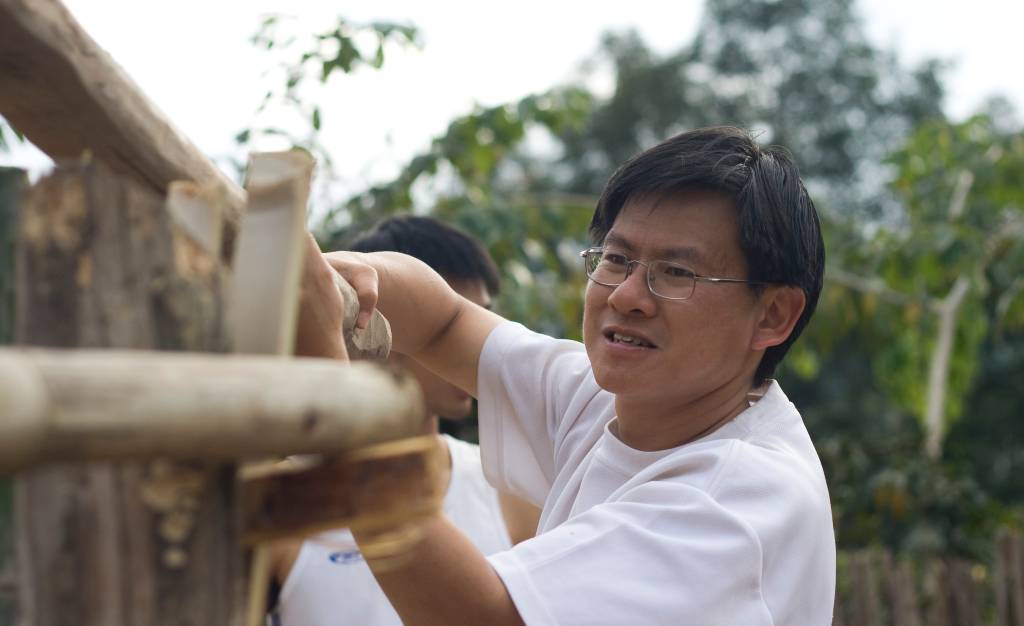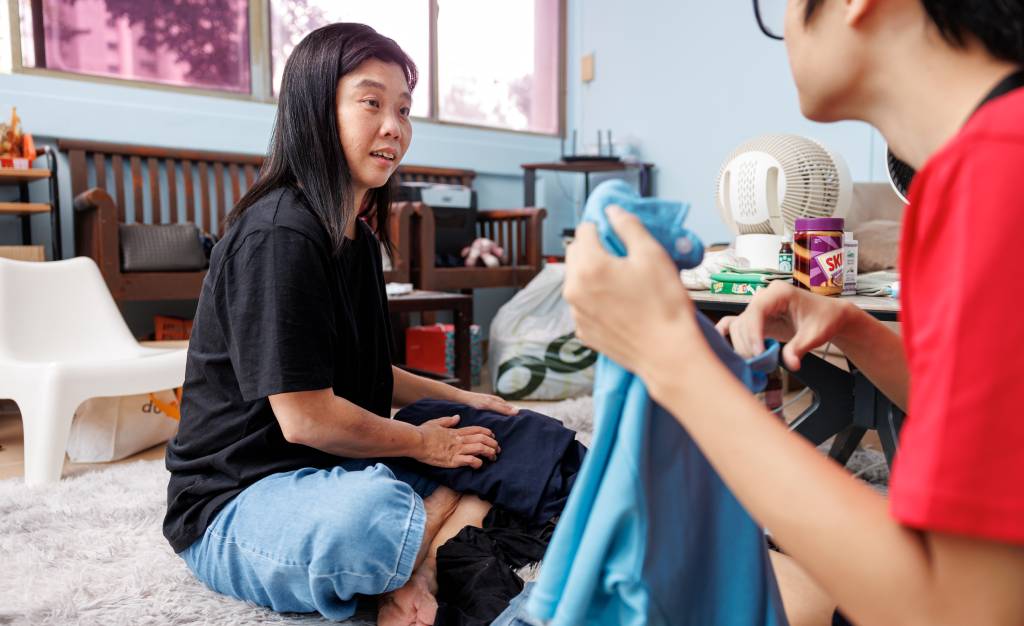

“Sorry I haven’t come for a while—my wife has been in hospital after being diagnosed with cancer,” Peter Lim said as he settled onto a stool beside Zarinah binte Daros, a resident at MWS Nursing Home – Yew Tee (YTNH).
Responding with concern, Zarinah said, “I will pray for her.” Following a brief exchange on his wife’s condition, Peter reached into his tote bag and began pulling out a few gifts. Among them: a 2026 Braille Calendar and a talking clock—everyday essentials for Zarinah, who is visually impaired.
As she spoke, Peter focused on her voice. He does not read faces or gestures. Instead, as a visually impaired pastoral care volunteer, Peter relies on attentive listening to journey with residents who often feel unseen.
A surprise discovery
It was a few months into volunteering at MWS YTNH that Peter discovered Zarinah was a resident there. The two were long-lost childhood friends who had studied together at the Singapore School for the Blind (now known as Lighthouse School).
“I was surprised to find her here because I remembered her as a capable and mobile person,” Peter shared. “When I asked what had happened, she told me she had gone through multiple surgeries and was in and out of hospital. One day, her family decided not to take her home. She stayed in hospital for a long time, and eventually, the hospital arranged for her to move here.”
Since then, Peter has continued to visit Zarinah from time to time, occasionally with his wife, who also went to the same school. Sensing that Zarinah needed companionship, he brought their former schoolmates to visit her too. “I’ve been very blessed, and I feel it’s important to give back,” Peter said. “Volunteering is one way I can serve society and share God’s love. We don’t always have to preach—God’s love can be shown through our actions as well.”
Family to those without one
It is individuals like Zarinah—those abandoned by or estranged from their families—that Peter feels a “special burden” for. The father of one, who works in a call centre, chose to volunteer at a nursing home because it is “where many people lack family support”.
Peter recalled one female resident who would say that her children were “useless” and were just waiting for her to die.
“After each visit, she would always say, ‘Thank you for coming to visit me. You are my new family,’” he shared. For Peter, those words are deeply affirming—evidence that, in a small yet meaningful way, their presence has filled the void left by absent children.
This ability to “make a difference” is what keeps Peter going. Through conversation, music, prayer and Scripture, he engages residents according to their needs. “While many residents may no longer have family support, we can become their extended family,” he said. “We can show them that there are still people who care, and that they are not forgotten.”
The gift of disability
A graduate of the Biblical Graduate School of Theology with a Master in Christian Studies, Peter has a long-held passion for ministry. Beyond healthcare institutions, the 59-year-old also volunteers with a prison fellowship ministry where he journeys with inmates, ex-offenders and their families.
At times, Peter’s presence alone speaks volumes. “Many of the people I visit feel encouraged that I can still come and care for them despite my disability,” he shared. “That gives them hope that their own lives still have meaning.”
He recalled an encounter with an elderly inmate—a notorious gangster who had been in and out of prison several times. After Peter shared his life story during an anti-gang programme in prison, the man approached him and said, “You cannot see, but you can still work, care for people and lead a very meaningful life. You make me very, very malu (ashamed in Malay). When I come out this time, I must not waste my life coming back here again.”
You cannot see, but you can still work, care for people and lead a very meaningful life. You make me very, very malu (ashamed in Malay). When I come out this time, I must not waste my life coming back here again. ~ Peter Lim
Born with serious eye conditions that left him completely blind by the age of 10, Peter draws strength from John 9:1-3, where Jesus explains that a man was born blind not because of sin, but so that the works of God might be displayed in him. “That passage reminds me that God’s glory can be made known through my life,” Peter said. “So, I truly believe that being blind is a blessing.”
One question he is often asked is whether he wishes to be healed. Peter paused before answering. “Of course, if I could see, I could do many things and go many places on my own,” he said. “But if being able to see causes me to be distracted by the things of this world and lose my faith and calling, then I would rather not see. Life on earth is temporary. I would rather remain blind and faithful now and see my God in heaven.”
Counting blessings
Not being able to read facial expressions or body language is one of Peter’s greatest challenges in his volunteer work. He relies on being paired with a sighted partner to navigate spaces and interpret social cues. Yet these limitations have never deterred him.
Journeying with the sick, the frail, and the abandoned has also taught Peter to count God’s blessings. “When I see the condition of the people I visit, I realise that not being able to see is actually a very small problem,” he said. “It has helped me become more grateful and to live a life of gratitude.”
Keen to make a difference in someone’s life? Join us as an MWS volunteer at https://mws.sg/volunteer or email volunteer@mws.sg.
By the Methodist Welfare Services Communications Team. / Photos courtesy of Methodist Welfare Services